Sustainability benchmarks are advancing over time, demanding higher performance thresholds from companies. What is behind this development?
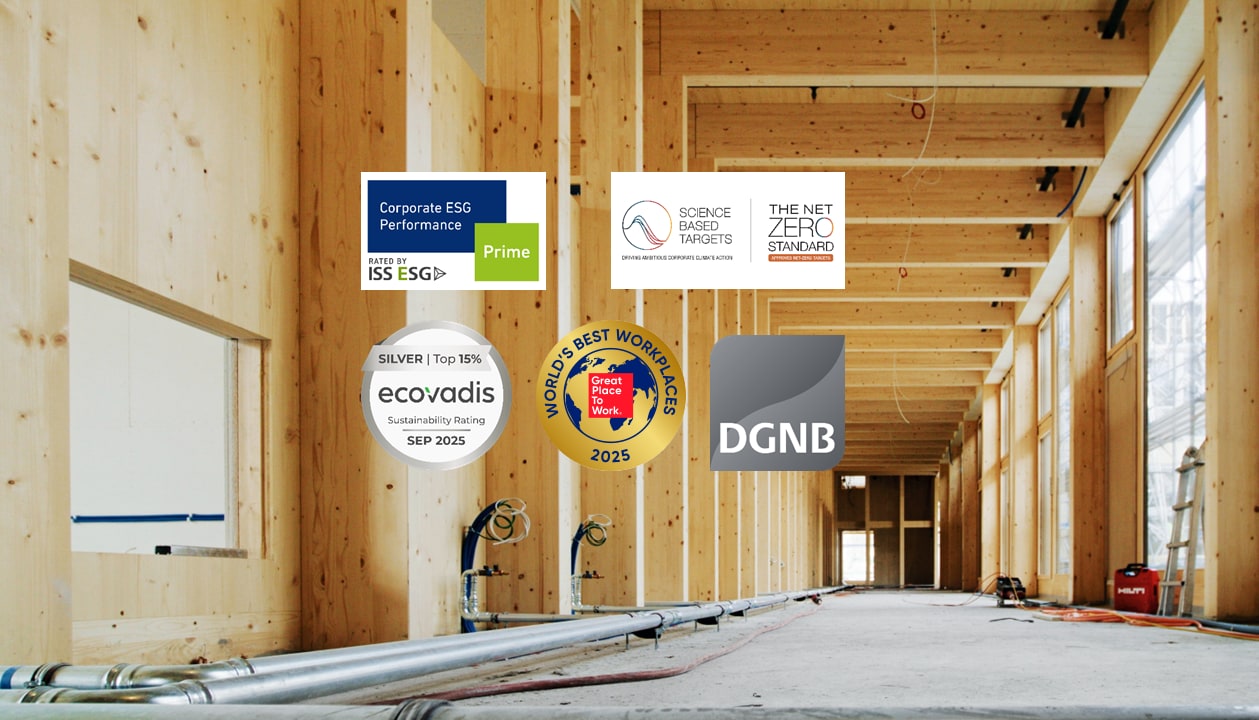
Ratings typically reflect the overall progress within an industry. As standards are evolving, rating agencies continuously refine their scoring models and constantly lift the bar for achieving a top rating, such as the EcoVadis Gold rating. Looking at Hilti’s EcoVadis rating for this year illustrates the dynamic. After four years at Gold, we moved to Silver this year, just one point below our rating from last year. For us, this is a clear signal and motivator for further accelerating our sustainability efforts.
Beyond certification, how does Hilti contribute to driving sustainability in the construction industry?
We aim to contribute to elevating the sustainability standards in our industry with our commitments and memberships in sustainability committees. The SBTi has validated our CO₂ reduction targets to reach net-zero emissions by 2050. We believe that this sends a strong signal about our goals. We’re also committed to the UN Global Compact and participate in the DIN (the German ISO body) working group to advance sustainability measurement standards in the construction industry. And as a member of the World Business Council for Sustainable Development we contribute to the global sustainability dialogue.
What steps does Hilti take to elevate its sustainability performance in the future?
Independent ratings help us stay accountable. We recognize that keeping pace is both a challenge and a responsibility. Looking ahead, we remain focused on achieving our net-zero target by 2050 and are intensifying our efforts to reduce our carbon footprint. We focus on strategic levers across the value chain and have identified great potential in the material and design phase that supports decarbonization and creates value for our customers: using materials smartly and using less overall.
By designing tools to be more modular we will enable more efficient repairs, extend product lifetimes and reduce waste. We will improve recyclability and prioritize low-carbon and recycled materials. Going forward, we are optimizing designs to reduce component materials and we are driven to further enhance tool performance while reducing energy consumption and using cleaner energy sources.
Every step moves us closer to a more sustainable built environment.